
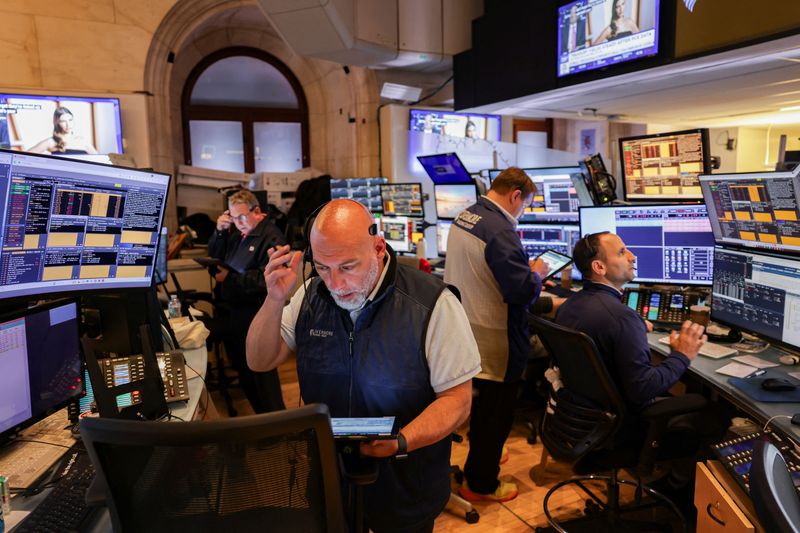
Futures linked to the main U.S. stock indices are hovering just above the flatline, with all eyes on a long-awaited Federal Reserve interest rate announcement. Analysts anticipate that the U.S. central bank will deliver a so-called "hawkish cut," slashing rates but putting a cap on possible reductions in the future. Still, rate markets are factoring in more easing in 2026, as President Donald Trump -- a long-time supporter of quick borrowing cost cuts -- reportedly prepares to hold a final round of interviews with candidates to become the new Fed Chair. On the earnings front, cloud-computing giant Oracle’s artificial intelligence plans will be under scrutiny when it reports after the closing bell.
1. Futures steady
U.S. stock futures pointed slightly higher on Wednesday, as investors geared up for the much-anticipated -- and potentially deeply contested -- Fed rate decision.
By 02:52 ET (07:52 GMT), the Dow futures contract was mostly unchanged, while S&P 500 futures and Nasdaq 100 futures had both ticked up by 0.1%.
The main averages on Wall Street were mixed in the prior session, with much of the attention swirling around the start of the Fed’s two-day policy meeting.
Both the blue-chip Dow Jones Industrial Average and benchmark S&P 500 ended lower on Tuesday, while the tech-heavy Nasdaq Composite gained 0.1%.
Partially weighing on sentiment was a marginal increase in U.S. job openings in October, although hiring remained subdued and resignations were around their lowest level in five years -- all potential signs of widespread economic uncertainty that some economists have suggested is linked to sweeping U.S. tariffs.
2. Fed expected to deliver "hawkish cut"
The report from the Labor Department underscored expectations that the Fed will likely cut interest rates at the conclusion of its gathering on Wednesday, but offer up a more hawkish outlook for the months ahead.
According to CME FedWatch, the chances of a quarter-point reduction in borrowing costs currently stands at roughly 88%. In theory, slashing rates -- which the Fed has already done in September and October, bringing its target range down to 3.75% to 4% -- can help spur investment and hiring, albeit at the risk of reigniting inflationary pressures.
While markets are widely confident that a rate cut is impending, media reports have said policymakers could be unusually divided over such a move, citing worries over sticky price gains and a relative dearth of fresh economic data due to a record-long government shutdown. A new summary of Fed members’ economic projections is also slated to be unveiled.
Looking to appease both sides of the policy argument, Fed Chair Jerome Powell is reportedly set to advocate for a drawdown this month and then use his post-meeting news conference to signal that the bar will be high for any further easing.
Still, establishing this high bar may be difficult. By January, officials will have had a chance to parse through more up-to-date employment and inflation numbers, and it is not clear what policy trajectory these figures could support.
3. Trump planning to start final round of Fed Chair interviews - report
Meanwhile, President Donald Trump is aiming to begin the final round of interviews for the next Fed Chair in the coming days, according to the Wall Street Journal.
Citing senior administration officials, the WSJ said Trump and some of his aides are scheduled to interview former Fed Governor Kevin Warsh on Wednesday, and meet with other candidates soon.
One of those will be Kevin Hassett, the White House economic adviser many reports have described as the frontrunner to replace Powell when his term at the helm of the Fed ends next year.
Hassett is a close ally of Trump, who has long badgered the Fed and Powell to aggressively and rapidly lower interest rates to help boost the economy. Some economists have predicted that Hassett could advocate for such quick easing, although, because he would have just one vote in the 12-member Federal Open Market Committee, his influence may be limited.
Yet, as analysts at ING flagged in a note, rates markets have priced in "so much easing" ahead, despite projections for a so-called "hawkish cut" from the Fed today.
"Presumably, this is the Kevin Hassett effect, where his arrival at the Fed in February can throw a dovish cloak over the FOMC outlook," the ING analysts including Chris Turner and Frantisek Taborsky said.
4. Oracle to report
Oracle is set to headline the earnings calendar on Wednesday, with analysts keen for the cloud computing giant to offer more insight into its artificial intelligence ambitions.
Fueled by a partnership with ChatGPT-maker OpenAI, Oracle has transformed its image this year from a smaller player in the cloud business to an essential provider of the rented computing power needed to underpin AI models.
A massive contract backlog of over $400 billion sent Oracle’s share price skyrocketing earlier this year, briefly propelling the company up to a market valuation near a trillion dollars and temporarily making co-founder Larry Ellison one of the world’s richest people.
However, that enthusiasm has since shown signs of fading, as observers fret over whether Oracle has relied too heavily on OpenAI and borrowed too much to fund a buildout of data centers.
5. Adobe earnings ahead
Adobe is also due to report its latest quarterly earnings after the closing bell on Wall Street.
Shares of the firm behind creative products like Photoshop and Acrobat have slumped by more than 21% so far this year, well underperforming the tech-heavy Nasdaq Composite.
In a note to clients, analysts at Stifel said it is "no secret" that a key "overhang" for Adobe’s stock price has been the belief that AI will be a disruptive force to creative departments, "making creators more efficient by orders of magnitude and shrinking the number of addressable seats over time." A "seat" refers to a pass allowing a user to access Adobe’s apps and services.
The analysts including J. Parker Lane and Jack McShane said that catalysts to "quickly turn sentiment around" on Adobe’s stock price are "foggy," although they said a "critical and successful AI-induced strategy pivot" at the company is in its "early days."
Adobe, whose tools are widely utilized in the photography and film industries, could be particularly bolstered by positioning itself as a sort of "Switzerland" in the AI race, becoming a central hub of generative AI where users can "test, leverage, and pay for third-party model usage," the analysts said.


 한국어
한국어
 Tiếng Việt
 中文
中文