
By Rae Wee
SINGAPORE (Reuters) - The U.S. dollar was struggling to make headway against its peers on Monday, though it traded in a tight range as investors awaited fresh catalysts this week that could offer clues on the outlook for U.S. interest rates.
Minutes of the Federal Reserve's July policy meeting and a speech from Chair Jerome Powell at Jackson Hole are likely to be the main drivers of currency movement this week, which will also see inflation data from Canada and Japan alongside Purchasing Managers' Index readings across the U.S., euro zone and UK.
The euro last bought $1.1026 while sterling rose to a one-month high of $1.2950 in an otherwise muted start to the Asian trading session, as bets for an imminent start to the Fed's easing cycle pressured the dollar.
Against a basket of currencies, the greenback fell 0.06% to 102.40.
Traders have fully priced in a 25-basis-point rate cut in September, with a 24.5% chance of a 50 bp move. Futures point to over 90 bps worth of easing by year-end.
"Markets will be laser focused to what Powell has to say at the end of this week, and on that, I think it will be a great opportunity for Powell to either endorse or push back market pricing," said currency strategist Carol Kong at Commonwealth Bank of Australia (OTC:CMWAY) (CBA).
"I think he'll at least greenlight a rate cut at the September meeting. If anything, I think he'll try to retain optionality because we do have some more data before the next meeting."
CFinancial markets had a turbulent start to August after a slew of softer-than-expected U.S. economic data - in particular, a weak jobs report for July triggered severe volatility as investors feared the world's largest economy was headed for a recession and that the Fed was being slow in easing rates.
With those worries now moderating, traditional safe haven assets such as the yen - which received a boost from a flight to safety - have given up some of their early August gains.
The Japanese currency was last 0.2% lower at 147.93 a dollar, having fallen some 4% from a seven-month high at the start of the month.
Japanese investment data on Friday confirmed that after a bout of turmoil, investors were back to betting on the Bank of Japan going slow on rate rises and on the yen staying cheap.
"Given financial markets have calmed down and volatility has eased, I think it is possible that dollar/yen can recover more, perhaps to 150, as volatility continues to move back lower," said CBA's Kong.
The New Zealand dollar rose 0.16% to $0.6062, while the Australian dollar hit a one-month high of $0.66865.
The Aussie has been drawing support from a still-hawkish Reserve Bank of Australia after Governor Michele Bullock on Friday said it was premature to be thinking about rate cuts.
Her comments came just days after the Reserve Bank of New Zealand delivered its first rate cut in over four years.
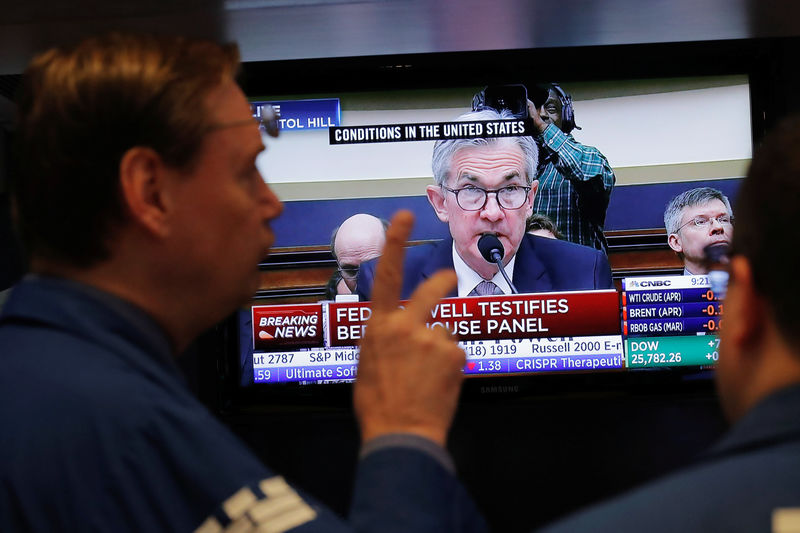
Investing.com -- The future trajectory of U.S. interest rates could become clearer this week when Federal Reserve Chair Jerome Powell speaks at the central bank’s annual Jackson Hole retreat. Before then, the Democratic National Convention gets underway, global PMI data will shed light on economic strength and energy markets will likely remain volatile amid elevated geopolitical tensions. Here's your look at what's happening in markets for the week ahead.
1. Jackson Hole
Fed Chair Jay Powell is due to deliver the keynote address at the central bank’s annual economic symposium in Jackson Hole, Wyoming on Friday at 10:00am ET (14:00GMT).
Markets will be laser focused on what he signals about the pace and timing of rate cuts over the coming months.
Hopes for an economic soft landing are once again propelling U.S. stocks higher, as recent positive data relieved worries over the prospect of a recession after a growth scare triggered a brutal selloff earlier this month.
Most market participants believe the Fed will cut rates at its upcoming September meeting, with the main debate being over the size of the cut - a quarter percentage point or a half point.
2. U.S. data
The Fed is to publish what will be closely watched minutes of its July meeting on Wednesday. The Fed left the door open to a September rate cut last month with Powell acknowledging progress on inflation.
Also Wednesday, the Bureau of Labor Statistics is slated to publish a preliminary estimate of the benchmark revision to the level of nonfarm payrolls for March 2024.
On Thursday the weekly report on initial jobless claims will be released.
Several Fed officials are also due to make appearances during the week including Fed Governor Christopher Waller, Atlanta Fed President Raphael Bostic and Fed Vice Chair for Supervision Michael Barr.
3. Democratic Convention
The U.S. presidential race is set to heat up as Democrats aim to boost Vice President Kamala Harris' candidacy during the party's convention in Chicago, starting Monday. Over the four-day event, prominent Democratic figures are scheduled to deliver speeches aimed at consolidating support for Harris.
Harris, who entered the race following President Joe Biden's decision to step down, has energized the Democratic base and narrowed the gap with Republican candidate Donald Trump in some opinion polls. She has even surpassed Trump in several betting markets ahead of the November 5 election.
As the race tightens, investors are keen to gain clarity on Harris' policy positions. Notably, Harris has underscored her commitment to preserving Federal Reserve independence, a stance that sharply contrasts with the views of her Republican rival, former President Trump.
4. PMI data
Purchasing managers' indexes deliver a real-time snapshot of economic activity and - with most of them out on Thursday - will provide an important insight into the outlook for global growth.
July's PMIs suggested an economic slowdown combined with persistent inflation, showing why central banks are in a dilemma.
U.S. manufacturing activity weakened, and German numbers were surprisingly dour, indicating that the Eurozone’s largest economy is contracting. But manufacturers' input prices in advanced economies hit an 18-month high.
Inflation will dictate the pace and depth of future rate cuts. A repeat of July's dour PMI data might mean monetary easing happens more slowly than markets would like.
5. Energy markets
Global energy markets have been experiencing volatility amid a mix of risk factors, with no immediate relief in sight. Recent concerns about escalating conflict in the Middle East have driven international crude oil prices above $80 a barrel, reflecting fears over potential supply disruptions from the region.
Simultaneously, uncertainties regarding oil demand, particularly from China, are capping further gains in crude prices.
European wholesale gas prices have also shown significant fluctuations, exacerbated by the potential disruption of Russian gas supplies through Ukraine. The ongoing conflict near the Russian town of Sudzha, a key transit point for gas flowing into Ukraine, has raised concerns about a possible halt in gas deliveries before the expiration of a five-year agreement with Gazprom.
--Reuters contributed to this report
By Danial Azhar and Rozanna Latiff
KUALA LUMPUR (Reuters) -Malaysia's economy expanded at its fastest rate in 18 months in the second quarter helped by stronger household spending, exports and investment, with the central bank forecasting full-year growth to come in near the upper end of its forecast range.
Gross domestic product grew 5.9% in the April-to-June period, data showed on Friday, accelerating from 4.2% in the first quarter and surpassing analysts' and early government estimates for a 5.8% rise.
Growth in the period was the quickest since the fourth quarter of 2022, when the economy expanded 7.4%.
On a quarter-on-quarter seasonally adjusted basis, GDP rose 2.9%, compared with a 1.5% rise in the January-to-March period, data from Bank Negara Malaysia (BNM) and the Statistics Department showed.
Full-year 2024 growth was expected to come in at the upper end of the central bank's forecast of 4%-5%, driven by stronger domestic and external demand, BNM Governor Abdul Rasheed Ghaffour said.
"Household spending will remain the anchor of growth for the rest of this year, with continued expansion in employment and income as well as larger policy support and...strong investment activities," he said.
In 2023, the economy had expanded less than expected, rising 3.7% amid weak global demand.
The ringgit currency is also expected to receive additional support in the coming months amid narrowing interest rate differentials between the United States and Malaysia, the governor said.
The ringgit has recovered from a 26-year-low against the U.S. dollar struck in February, and has now gained 3.3% so far this year.
Last month, the central bank held its key interest rate steady at 3.00%. It said on Friday that inflation would remain manageable even as it trended higher following diesel subsidy cuts in June.
Headline and core inflation averaged 1.8% in the first half of 2024, BNM said. It projects headline inflation will range between 2% and 3.5% for the year.
Analysts expect BNM to keep interest rates unchanged for the rest of the year, flagging the risk of higher inflation as Malaysia continues to pursue further subsidy cuts. The government has plans to adjust subsidies for RON95 fuel but has not yet said when the proposal will be implemented.
"We believe BNM will continue to remain vigilant in their conduct of monetary policy especially on the price front. They have maintained their inflation forecasts...which indicates some degree of uncertainties over the prospect of the country's inflation," Bank Muamalat Malaysia chief economist Mohd Afzanizam Abdul Rashid said.
Capital Economics said in a note that despite a better-than-expected performance, it still expected Malaysia to face a slowdown ahead amid declining commodity prices, inflation risks and a fading boost from tourist arrivals.
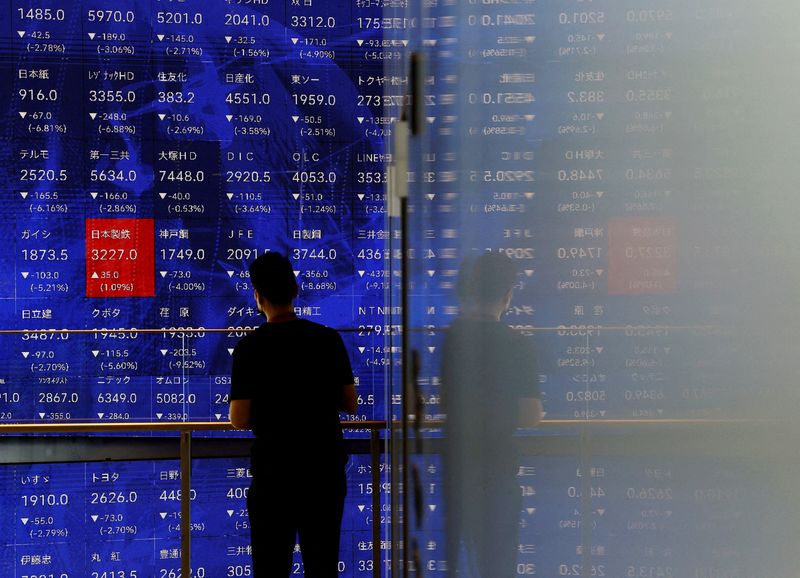
(Reuters) - Foreign investors heavily bought into Japanese stocks in the week to Aug. 10, encouraged by policymakers' signals to stabilize the market following recent turmoil which had sent shares into their biggest one-day plunge since 1987.
Cross-border investors bought a net 521.9 billion yen ($3.51 billion) of Japanese shares in the week, reversing three consecutive weeks of net selling, according to finance ministry data.
Last week, Japanese policymakers signalled action to prevent further declines in the stock market, while the Bank of Japan indicated it would keep rates steady amid market instability, following a historic 12.4% drop in the Nikkei share average on Aug. 5 on fears of a recession in the U.S. and the unwinding of carry trades funding with cheap yen.
But those worries quickly faded and the Nikkei share average has surged over 20% since reaching a nine-month low of 31,156.12 on Aug. 5.
Foreigners also reversed an eight-week Japan bond selling trend last week, becoming net buyers. They acquired a net 1.44 trillion yen in long-term bonds, the largest amount since May 11, and a net 561.8 billion yen in short-term securities.
Japanese investors bought 1.54 trillion yen worth of long-term overseas bonds last week, marking the largest weekly net purchase in 12 weeks, and also acquired short-term instruments totalling a net 453.5 billion yen.
Japanese investors, however, shed foreign shares worth a net 328.1 billion yen after three weeks of net purchases in a row.
($1 = 148.9000 yen)

By Makailah Gause
NEW YORK (Reuters) - The average rate on the popular U.S. 30-year mortgage rate was little changed near the lowest level in over a year this week, as signs of cooling inflation have held down the Treasury bond yields used in setting home loan costs.
The 30-year fixed-rate mortgage averaged 6.49% during the week ending August 15, up fractionally from 6.47% in the prior week, the lowest since May 2023, mortgage finance agency Freddie Mac said on Thursday.
“In 2023, the 30-year fixed-rate mortgage nearly hit 8 percent, slamming the brakes on the housing market," Freddie Mac Chief Economist Sam Khater said in a statement.
"Now, the 30-year fixed-rate hovers around 6.5 percent and will likely trend down in the coming months as inflation continues to slow. Lower rates are good news for potential buyers and sellers alike.”
It averaged 7.09% during the same period a year ago.
Mortgage applications increased by nearly 17 percent last week as mortgage rates continued to fall, Mortgage Bankers Association data showed on Wednesday, enticing homeowners who had bought with high-rate mortgages in the last year to rush to refinance those loans.
"The significant increase was led by a 35 percent jump in refinances and also included a 3 percent increase in purchase applications. While the refinances remain strong, we expect that the purchase market will continue to gain momentum as mortgage rates continue to fall,” MBA Chief Executive Bob Broeksmit said in a statement.
By Rae Wee
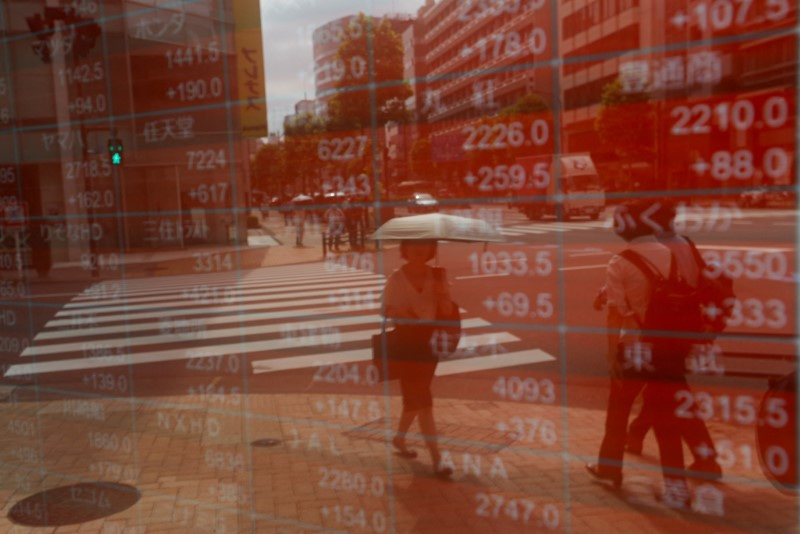
SINGAPORE (Reuters) - Asia shares were headed for a weekly gain on Friday and Japan's benchmark Nikkei was poised for its best week in over four years as upbeat risk sentiment spilled over from Wall Street, while the dollar and U.S. Treasury yields held broadly steady.
Last week's market turmoil was replaced by calmer conditions this week after a raft of U.S. economic data allayed recession fears in the world's largest economy and pushed back against expectations for aggressive U.S. rate cuts.
"Our assessment is that the market fallout from the weak early August U.S. data was disproportionate and in large part reflected the rapid unwind of crowded positions in some markets," said Jonas Goltermann, deputy chief markets economist at Capital Economics.
"While the risk of a recession in the U.S. has increased a little, there are few signs of a more substantial crisis brewing."
MSCI's broadest index of Asia-Pacific shares outside Japan advanced 0.34% in early trade and was set to rise 1.3% for the week, while U.S. futures extended gains following a strong overnight cash session on Wall Street.
S&P 500 futures rose 0.09%, while Nasdaq futures added 0.17%.
Strong U.S. retail sales data and low weekly jobless claims were the latest shot in the arm for the positive risk mood, following a benign inflation report earlier this week that reaffirmed bets for imminent Fed rate cuts, but likely at a measured pace.
Markets are now pricing in just a 25% chance of a 50-basis-point cut from the Federal Reserve next month, down from 55% a week ago, according to the CME FedWatch tool.
"The totality of data tells us disinflation is continuing and the Fed is almost certain to cut rates in September by 25bps," said David Chao, Invesco's global market strategist for Asia Pacific ex-Japan.
"But I do believe that the July inflation report diminishes the chances of a super-size cut, though this was never in the cards."
Japan's Nikkei got off to a strong start and jumped 2.7%.
The Nikkei, which suffered heavy losses last week exacerbated by the unwinding of yen-funded carry trades, was poised for a weekly gain of 7.6%, its best performance since April 2020.
Friday's gains were in part helped by a weaker yen which last stood at 149.08 per dollar, languishing near a two-week low of 149.40 hit in the previous session and some distance away from last week's seven-month peak.
The Swiss franc, which also surged last week on the back of a flight to safety, was little changed at 0.8716 per dollar and looked set to lose 0.7% for the week.
In other currencies, the euro struggled to break above the $1.10 level against a firmer dollar, which was buoyed by elevated U.S. Treasury yields.
The two-year yield hovered near an over one-week high and last stood at 4.0846%, while the benchmark 10-year yield steadied at 3.9112%. [US/]
In commodities, oil prices edged lower on Friday, though were set for a weekly gain as the upbeat U.S. economic data eased investor worries about a potential recession in the top oil consuming nation.
Brent crude futures dipped 0.19% to $80.88 per barrel, while U.S. West Texas Intermediate crude futures eased 0.28% to $77.94 a barrel. Still, the two were eyeing a weekly gain of more than 1%. [O/R]
Spot gold ticked up 0.07% to $2,457.79 an ounce. [GOL/]
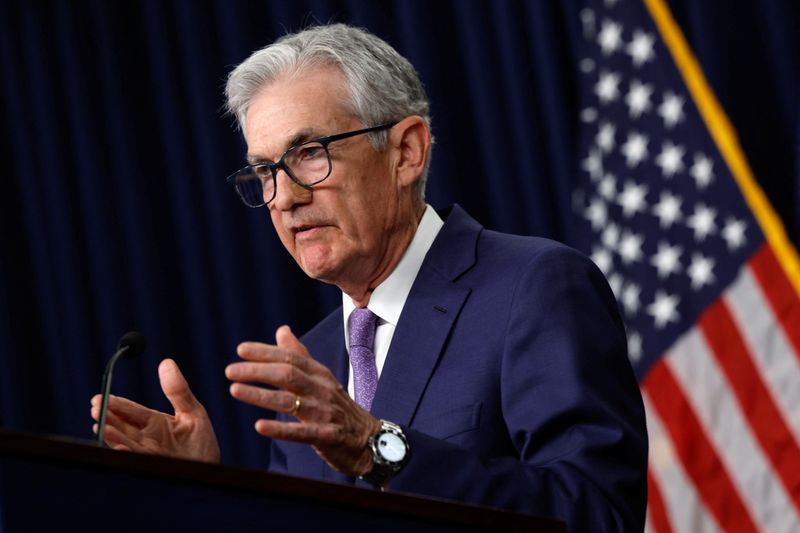
Investing.com -- Fed Chairman Jerome Powell is likely lay out the case for rate cuts starting September when he takes to the stage at the annual central bank symposium in Jackson Hole, Wy., slated for next week but the Fed chief is expected to stress that cuts would be "orderly," downplaying the prospect of a 50 basis point cut next month.
"We expect Chair Powell will lay out a case for an orderly withdrawal of monetary policy restrictiveness in a speech at Jackson Hole the morning of Friday, August 23, and by orderly, we mean 25 bp rate cuts, rather than 50 bp," economists' at UBS said in a recent after updating their rate cut call.
"We expect three 25 bp rate cuts this year, one at each of the September, November and December FOMC meetings," they added, expecting that the Fed's September meeting will reflect consensus among voting members that fed policy was now restrictive amid slowing growth.
Powell is expected "to make the case to take out a little more restrictiveness in the next few meetings than previously signaled, to better position policy, something of a recalibration," UBS said, but remain data dependent.
But the Fed chief is unlikely to signal that rate cuts will be ongoing as he is expected to "remain data dependent and caution that ongoing rate cuts after any recalibration should depend upon ongoing progress on inflation toward 2%, weighed against the risks to the labor market expansion," the economists said.
Many on Wall Street have called for aggressive cuts in the wake of the weaker July nonfarm payrolls report that triggered the Sahm Rule -- a measure suggesting a recession is underway when the three-month average U.S. unemployment rate rises by 0.50% or more from its 12-month low -- but against the backdrop of slowing but real GDP growth ... "would not seem that ominous," they added.
Others agree, with Morgan Stanley downplaying the recession signal from the rise in unemployment rate isn't as worry as in previous cycles because labor demand is holding up relatively well.
"The recessionary signal from the unemployment rate should come primarily from the fall in labor demand, and so the current rise in the unemployment rate, though seemingly as large as the beginning of other downturns, is actually only about half the signal as in the past," Morgan Stanley added.
While the Fed may pause rate cuts to reassess, UBS says it is "comfortable" with its projection that headline PCE inflation touches 2.0% and core 2.1% in the second quarter of next year, encouraging the Fed to continue with rate cuts next year.
"While successive three 25 bp rate cuts this year would reposition policy more in line with a policy rule, the FOMC may want to just keep going in 2025 since our forecast expects further slowing from here, if not recession," it added.

LONDON (Reuters) - British consumer price inflation rose to 2.2% after two months at the Bank of England's 2% target, a slightly smaller increase than economists expected, and services inflation, closely watched by the BoE, slowed sharply, official data showed.
Economists polled by Reuters had forecast the annual headline CPI rate would rise to 2.3%.
Sterling fell sharply against the U.S. dollar after the data was published on Wednesday.
When the BoE cut interest rates from a 16-year high of 5.25% at the start of this month, it said May and June's 2% inflation readings probably marked a low point for inflation.
The central bank expected CPI to rise to 2.4% in July and reach around 2.75% by the end of the year as the effect of sharp falls in energy prices in 2023 faded, before returning to 2% in the first half of 2026.
British inflation peaked at a 41-year high of 11.1% in October 2022 driven by a surge in energy and food prices after Russia's full-scale invasion of Ukraine as well as COVID-19 labour shortages and supply chain disruption.
The BoE remains relatively focused on longer-term inflation pressures, including services prices and wages as well as general labour market slack.
Wednesday's data showed that annual services price inflation fell to 5.2% in July from June's 5.7%, lower than the Reuters poll forecast of 5.5% and the lowest since June 2022. BoE staff had predicted a drop to 5.6%.
Official data on Tuesday showed that annual wage growth excluding bonuses slowed to its lowest in nearly two years at 5.4%, in line with economists' forecasts but still nearly double the rate the BoE sees as consistent with CPI staying at 2%.
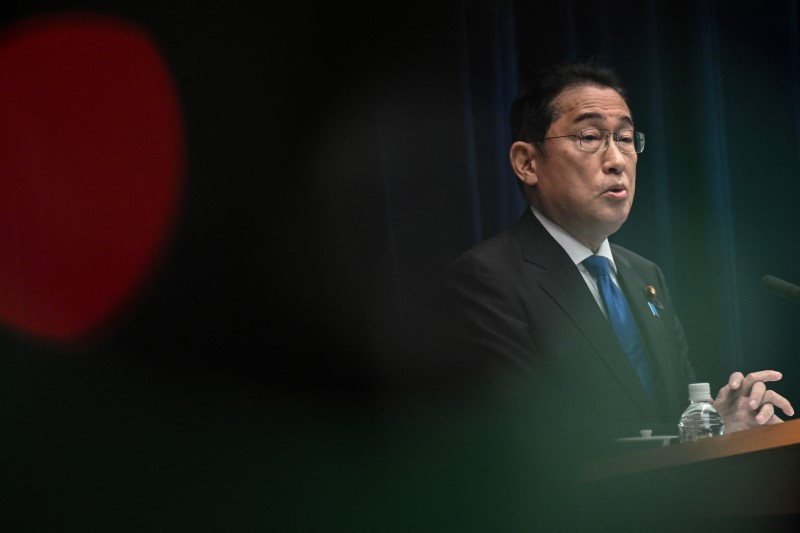
(Reuters) -Japanese Prime Minister Fumio Kishida said he will step down in September, ending a three-year term marred by political scandals and paving the way for a new premier to address the impact of rising prices.
Kishida's decision to quit triggers a contest to replace him as president of the ruling Liberal Democratic Party (LDP), and by extension as the leader of the world's fourth-biggest economy.
Here are some reactions to the news from market and political analysts:
KOICHI NAKANO, POLITICAL SCIENCE PROFESSOR, SOPHIA UNIVERSITY, TOKYO
"I was expecting Kishida not to be able to run for quite some time. And that's to do with basically the statistics. He's already passed average tenure of an LDP prime minister by serving three years. And he's not anywhere near a position to be able to say, ‘I'm special, I need more time.’ So he was running against the odds to begin with.
"And at the end of the day, an LDP incumbent prime minister cannot run in the (party) presidential race unless he's assured of a victory. It's like the grand champion yokozunas of sumo. You don't just win, but you need to win with grace. And so if you can't do that, you're supposed to retire. It's considered to be unseemly for the president to run and to get defeated as an incumbent.
RINTARO NISHIMURA, ASSOCIATE OF THE ASIA GROUP, A WASHINGTON-BASED STRATEGIC ADVISORY FIRM, TOKYO
"It’s open field for the next president. Kishida's endorsement will matter as well. Will he back someone from his own faction, like Hayashi or Kamikawa, or ride the wave with another candidate, such as Ishiba, Kono, Koizumi. The new leader needs to be a fresh face, whether that means young or not associated with Kishida, and reform-minded, showing voters that the party will change.
"The new leader will have a tough job navigating this tough political environment and heading into a general election knowing the poll numbers are not looking good. An election is likely to be right after the new PM is sworn in, as new PMs tend to have a slight boost in poll numbers. It’s better to call before negatives come up."
MIKITAKA MASUYAMA, PROFESSOR AT THE NATIONAL GRADUATE INSTITUTE FOR POLICY STUDIES
"Support for the prime minister has been sluggish of late and the voices calling for his stepping down have been loud. The leader of the Liberal Democratic Party is tantamount to prime minister. Anyone in the position should be able to bring the party together and manage the government. Someone with experience is better than those who are just popular in voter polls.
"If Kishida picked (Foreign Minister Yoko) Kamikawa, and others in the LDP joined him, she could be the one."
SHOKI OMORI, CHIEF JAPAN DESK STRATEGIST, MIZUHO SECURITIES, TOKYO
"Political uncertainty isn’t good at all, with Mr. Kishida not even raising his hand for election. The market implication is that Japanese politics is going to be foggy, and whoever the LDP premier will be, the cabinet choice is going to be very unclear and thus the policy path is going to be a mystery. In short, risk-assets, particularly equities, will likely be hit the most, given foreign investors’ attention and big inflow/outflow in the markets.
"Market participants are going to dislike the uncertain situation, especially those investing in risk assets, such as equities. PM Kishida pushed for New NISA (investment accounts) and now he’s pulling back. Yen is going to depend on external factors especially U.S. data and the Fed. JGBs will still remain a supply/demand market. My initial view is that equities are going to be hit the most."
CHARU CHANANA, HEAD OF CURRENCY STRATEGY, SAXO, SINGAPORE
"While Kishida’s stepping down could bring some uncertainty, his low approval ratings mean a significant negative reaction from equities may be avoided."
MICHAEL CUCEK, PROFESSOR SPECIALISING IN JAPANESE POLITICS, TEMPLE UNIVERSITY, TOKYO
"He’s been a dead man walking for quite some time. That there was no way to add up the numbers so that he would get reelected was clear for a long time. Public discontent with Kishida was connected with the LDP’s entanglements with the former Unification Church, which became apparent after Abe’s assassination, as well as slush fund scandals, and the slide in the yen that increased inflation pressures."
TAKAHIDE KIUCHI, NOMURA RESEARCH INSTITUTE EXECUTIVE, TOKYO
"The Kishida administration at first raised market concerns by leaning to (re)distribution measures, but it later pivoted to expansionary policies such as the 'asset income doubling plan', which was well received by the markets. However, the administration has recently launched policies with unclear objectives such as tax cuts, giving an inconsistent impression on its policy focuses."
KENTA IZUMI, LEADER OF THE BIGGEST OPPOSITION CONSTITUTIONAL DEMOCRATIC PARTY (POST ON X), TOKYO
"The issues of the former Unification Church, political money and inflation countermeasures have been headache for him, but these problems are still unsolved."
RAHM EMANUEL, US AMBASSADOR TO JAPAN(POST ON X), TOKYO
"Under Prime Minister Kishida’s steadfast leadership, Japan and the United States have ushered in a new era of relations for the Alliance."

By Lucy Craymer
WELLINGTON (Reuters) -New Zealand's central bank slashed its benchmark cash rate for the first time since March 2020, sending the local dollar tumbling as policymakers flagged more cuts over the coming months saying inflation was converging on its 1% to 3% target.
The decision to reduce rates by 25 basis points to 5.25% came almost a year ahead of the Reserve Bank of New Zealand's (RBNZ) own projections, taking some market players by surprise.
The policy easing was in line with market pricing but defied most economists' expectations, with 19 of 31 economists in a Reuters poll having forecast the central bank to hold steady as they have since May 2023.
"The Committee agreed to ease the level of monetary policy restraint by reducing the OCR (official cash rate)," the central bank said in its statement.
“The pace of further easing will depend on the Committee’s confidence that pricing behaviour remain consistent with a low inflation environment, and that inflation expectations are anchored around the 2 percent target,” it added.
Investors reacted by knocking the kiwi dollar down 0.75% to $0.6032, erasing most of the 1% gains made overnight as soft U.S. producer price data slugged the U.S. dollar. Swaps shifted to imply another 29 basis points of easing by October and 67 basis points of easing by year end. Rates are seen near 3.0% by the end of 2025, well below the RBNZ's projection. Bank bill futures also jumped.
ASB Bank chief economist Nick Tuffley said he expects the RBNZ will continue steadily cutting the cash rate by 25 basis points in consecutive meetings.
“If inflation pressures evaporate faster than expected, the RBNZ may need to hasten the return to a more neutral setting of around 3.25%,” Tuffley added. ASB Bank along with Kiwibank announced they would cut their mortgage lending rates.
The RBNZ's forward guidance suggested at least three more cuts by the middle of next year, projecting the cash rate at 4.9% in the fourth quarter of 2024 and 4.4% in the second quarter of 2025. Previously, it had not expected to start cutting rates until the middle of 2025.
The minutes of the meeting, released alongside its statement, said the Committee observed that the balance of risks has progressively shifted since the May Monetary Policy Statement.
“With a broad range of indicators suggesting the economy is contracting faster than anticipated, the downside risks to output and employment that were highlighted in July have become more apparent,” the minutes added.
A global front-runner in withdrawing pandemic-era stimulus, the RBNZ has lifted rates 525 basis points since October 2021 to curb inflation in the most aggressive tightening since the official cash rate was introduced in 1999.
New Zealand's annual inflation has come off in recent months and is currently running at 3.3% with expectations that it will return to the central bank's target band in the third quarter of this year.
The rate hikes have sharply slowed the economy with meagre first quarter growth and recent data indicating still-subdued momentum.
New Zealand joins other central banks that are starting to ease rates. The European Central Bank, Canada, Sweden and Switzerland have all cut interest rates and an increasing number of analysts are now pencilling in a half-a-percentage-point rate cut for the Federal Reserve's September meeting.
New Zealand's neighbour Australia, however, is an exception to the global easing trend. The Reserve Bank of Australia last week ruled out near-term rate cuts.


 한국어
한국어
 Tiếng Việt
 中文
中文